

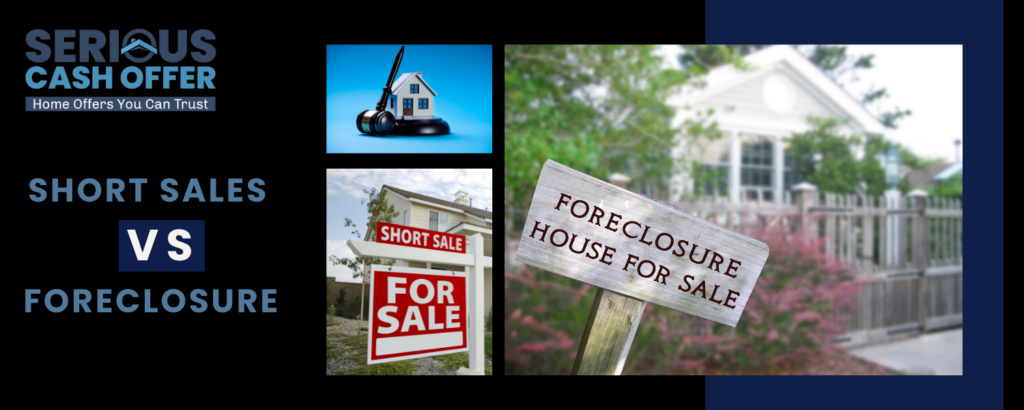
I’ve been buying houses for more than fifteen years, and I’ve seen homeowners go through some of the worst financial moments of their lives. If you’re struggling to make your mortgage payments, you’re not alone. If you’re falling behind on payments or worried that you will, knowing your options can make all the difference.
Allow me to walk you through the two most common distressed property scenarios, short sales and foreclosures. Both can be overwhelming, but they are very different paths with very different outcomes for both homeowners and buyers.
Short Sale vs Foreclosure: Complete Guide to Distressed Property Options
Here’s the scoop. A short sale is selling your home for less than you owe on your mortgage, but you have to have the approval of your lender. A short sale is an agreement between a mortgage lender and a financially distressed owner to accept a mortgage payoff amount less than the amount owed to facilitate a sale of the property. Basically, your lender agrees to take a loss in order to avoid the foreclosure process.
Foreclosure is another story. That’s when your lender legally takes your house back because you’ve stopped making payments. Some foreclosures require a court action (judicial foreclosures), and some don’t (nonjudicial foreclosures). You lose the house either way.
There were 322,103 foreclosure filings on U.S. properties in 2024, down 10 percent from 2023 and down 89 percent from a peak of nearly 2.9 million in 2010. Yet most do not know that foreclosure filings were down 10% in 2024, and are up almost 20% from 2024 to 2025. Both options affect your credit very differently. Both have tax implications that you need to be aware of. And both impact when you can buy another house down the road.
Prevention Strategies: Early Intervention and Mortgage Default Avoidance Techniques
Prevention is always better than a cure. If you’re reading this because you’re worried about missing payments, there are options before things get serious. Step one: Call your lender right away. “Don’t wait until you are three months behind. Most lenders have a loss mitigation department that works specifically with homeowners to avoid foreclosure. They’d prefer to work with you than go through the costly foreclosure process.
Document everything. Your income, your expenses, and why you are struggling. Doctors bills? Unemployed? Divorce? Lenders want to see hardship, not just financial difficulty. There’s a distinction. Call a HUD-approved housing counselor. These are no-cost services to help you understand your options and negotiate with lenders. They know what programs are available and can help you work through the paperwork.
Think about selling before you get behind. If you owe almost what your house is worth, your best bet could be selling it the old-fashioned way. Avoid the credit damage altogether.
Mortgage Relief Options: Government Programs and Lender Assistance Programs
There are a few government programs that may help homeowners avoid foreclosure. The Making Home Affordable program provides opportunities for qualifying homeowners to seek loan modifications, principal reductions, and refinancing. HARP (Home Affordable Refinance Program) helps homeowners who are current on their payments but have more than the value of their house. Even if you are underwater on your mortgage, you can still refinance to a lower payment.
HAMP (Home Affordable Modification Program) may reduce your monthly payment by lowering your interest rate, increasing the term of your loan, or through principal forbearance. Your monthly payment cannot be more than 31% of your gross monthly income. Homeowners with a VA loan have more options with the VA’s foreclosure avoidance program. FHA borrowers have access to FHA-specific loss mitigation programs.
Many lenders also have their own modification programs, in addition to government options. These can be temporary payment reductions, permanent changes, or repayment plans to catch up on missed payments. And don’t forget patience. This reduces or suspends your payments temporarily while you get back on your feet. It’s not forgiveness, but it buys you time.
Foreclosure Alternatives: Loan Modification, Deed in Lieu, and Payment Plans
There are other options to foreclosure, each with its own criteria and results. Loan modification changes the terms of your original loan. Your lender may lower your interest rate, extend the term of your loan, or even reduce the principal amount of your loan. It’s about making your payment affordable over the long haul.
A deed in lieu of foreclosure is when you give the deed to your house to the lender voluntarily. You sign the deed over, and they cancel the debt. It’s quicker than foreclosure and causes less damage to your credit score, but you still lose the house. Repayment plans give you time to make up missed payments. You make your regular payment plus a portion of what you owe. This is helpful if your financial problem was temporary.
A short refinance occurs when the lender allows you to refinance for less than what you owe. The distinction is ignored. This means you can stay in your home with a lower payment. Cash for keys programs pay you to leave of your own accord. The lender gives you money to get out and leave the house in good condition. It’s quicker and less expensive for them than eviction.
Understanding Short Sales: Definition, Process, and Timeline Requirements
Let me tell you the truth about short selling. They are not quick, nor are they simple, but they can save your credit and help you avoid foreclosure. A short sale can only happen with the lender’s consent, and the lender won’t consent unless the seller can prove hardship. You can’t decide to do a short sale just because you want to get out.
The first step is proving hardship. Loss of job, medical bills, divorce, death in the family. Your lender must be convinced that you cannot afford the payments and that your financial circumstances are unlikely to improve in the near future. You will need to provide a lot of documentation – tax returns, bank statements, pay stubs, hardship letter, and a comparative market analysis showing your house is worth less than you owe.
A short sale can be as quick as a few weeks or take several months. Short sales are complicated transactions and generally take more time to complete. Here’s the thing no one tells you: You might still owe money after the short sale. Some lenders go after deficiency judgments for the difference between what you owed and what they got. Negotiate the forgiveness of the deficiency into your short sale approval.
Homeowner Eligibility Requirements for Short Sale Approval and Processing
Short sale is not for the faint of heart. The lenders have their own criteria for assessing applications. You have to be in financial hardship. This is not just underwater on your mortgage. You will have to show that you can’t make your payments, and that your situation is not temporary.
Your house has to be worth less than what you owe. Let’s say you owe $300,000 and your house is worth $320,000. You’re not eligible. If the lender can recoup their entire loan amount through foreclosure, they won’t approve a short sale. Usually, you have to be behind on your payments or close to defaulting. Some lenders will consider a short sale for homeowners who are current but facing unavoidable default.
You can’t have major assets that the lender could lay their hands on. Your lender will not approve a short sale if you have $100,000 or more in savings accounts. They’ll want to see you drawing on those assets to pay down your mortgage. You must use the property as your main residence or an investment property that you’re having difficulty maintaining. Vacation homes seldom qualify unless you can demonstrate exceptional circumstances.
Market Value Assessment: Property Pricing Strategies in Distressed Sales Situations
There is a fine line in pricing a short-sale property. Price it too high, and you won’t move it. Set the price too low, and your lender will reject you. Start with extensive market research. Check out the recent sales of comparable properties in your neighborhood. Your real estate agent should provide you with a detailed CMA, showing what similar houses have sold for in the last 90 days.
Look at the condition of the property. Short sale properties are generally sold “as is.” If your house needs major repairs, factor that into your pricing strategy. Buyers are looking for a lower price on fixer-uppers. U.S. home prices rose 1.2% compared with last year, selling for a median price of $436,523. Median days on market was 55 days, up 7 percent year-over-year.
Since a short sale could take longer than a traditional sale, price it right to draw in serious buyers quickly. Find a real estate professional who is experienced with short sales. They know how to price properties to satisfy lenders and still appeal to buyers.
Lender Approval Process: Documentation, Negotiation, and Short Sale Authorization

Getting lender approval for a short sale involves a lot of paperwork and patience. This is what you are up against. You will submit a short sale package that includes your hardship letter, financial statements, tax returns, bank statements, and a purchase contract from a qualified buyer.
Your lender will get their own appraisal or broker price opinion (BPO) to check the value of your property. It can take weeks, and you can order more than one valuation if the first one doesn’t support the proposed sale price. The lender’s loss mitigation department reviews your file. They will determine if you really had a hardship and you really can’t afford to keep making payments. They will determine if accepting the short sale is less expensive for them than foreclosure.
You’re likely to be asked for more documentation. Lenders often require updated financials, especially if the short sale process takes a couple of months. Some lenders will require you to bring money to closing. This might be a couple of thousand dollars out of pocket to mitigate their loss. If you are dealing with companies like Serious Cash Offer, they know this process and can help you with the paperwork requirements. Their experience negotiating with lenders can be the difference between approval and denial.
Foreclosure Process Explained: Legal Steps, Timeline, and Homeowner Rights
Foreclosure is a legal process and varies from state to state. Knowing the timeline will help you plan your next steps. In 2024, the average time to foreclosure was 762 days, a 6% increase from 2023. But it varies a lot by state. The slowest foreclosure process in Q3 2024 was in Louisiana, with an average of 3,520 days, while the fastest was in New Hampshire, at just 165 days.
Usually, the process begins with a notice of default after several payments are missed. This gives you a definite time period to catch up on any missed payments, or you’ll face foreclosure proceedings. Your lender must sue to foreclose if your state requires judicial foreclosure. You will get court papers and have a right to respond. This process can last many months or even years.
In non-judicial foreclosure states, lenders can foreclose without going to court, but must follow certain notice requirements. It takes about 120 days, or four months, to complete a nonjudicial mortgage foreclosure. You have rights in the foreclosure process. You cure the default by paying off your debt. You are able to sell the property. You can file for bankruptcy to delay the foreclosure for now.
Legal Ramifications: Court Proceedings, Eviction Notice, and Property Rights
Foreclosure means losing your house, but there are also serious legal consequences. If you live in a judicial foreclosure state, you’re actually a defendant in a lawsuit. If you do not answer or you lose at trial, the court will enter a judgment against you. The judgment becomes part of the public record and can affect future applications for credit.
If you choose not to leave voluntarily, you could face eviction proceedings after the foreclosure sale. This creates another legal record that could make renting harder. Some states allow deficiency judgments. That is, your lender can come after you for the difference between what you owed and what they got out of the foreclosure sale. This debt can haunt you for years.
Typically, your homeowner’s insurance ends after foreclosure. However, you may still owe HOA fees or property taxes until the sale is finalized. It can halt foreclosure for a time with automatic stay provisions, but it won’t eliminate your mortgage debt unless you qualify for a Chapter 7 discharge.
Financial Consequences: Debt Forgiveness, Tax Implications, and Deficiency Judgments
A short sale and a foreclosure both have serious financial consequences beyond losing your house. In general, forgiven debt is taxable income. If your lender “forgives” $50,000 in a short sale, that could be taxable income. There is some protection in the form of the Mortgage Forgiveness Debt Relief Act, but it has limitations and expiration dates.
Deficiency judgments allow lenders to pursue you for any mortgage debt left unpaid after a foreclosure or short sale. Some states ban these judgments, others allow lenders to collect for years. Either way, your credit score will be severely damaged. Foreclosures usually have bigger declines than short sales, but both can cause your score to drop 100-200 points or more.
Future mortgages can qualify for different types of loans and situations. FHA loans might be available in as little as three years after a short sale, while conventional loans often have longer waiting periods. If you want to avoid some of these hassles, companies like Serious Cash Offer and other cash buyers can help you get out of your situation by buying your house fast so you can pay off your mortgage before foreclosure proceedings start.
Credit Score Impact: How Short Sales and Foreclosures Affect Your Credit Rating

Foreclosure and short sale both take a serious hit on your credit score, but the damage is different. Foreclosures typically lower your credit score by 200-400 points, depending on your starting point. The bigger the drop, the higher the credit score. If you begin at a 780, you could go down to 580 or below.
A short sale usually will hurt your credit less, knocking your score down by 100 to 200 points. Whether you were up to date when the short sale was approved or were already behind determines the impact. Late payments before either event make the damage worse. Each 30-day late payment can take 60-110 points off your score. Multiple late payments create a pattern that’s hard to break.
A foreclosure or short sale will stay on your credit report for seven years from the date of the first missed payment that triggered the event. But if you rebuild your credit responsibly, the impact will lessen over time. Other good-standing accounts help to keep damage down. Credit cards, car loans, or other accounts that are not past due can help your score recover more quickly by adding a positive payment history.
Recovery Timeline: Rebuilding Credit After Short Sale or Foreclosure Events
It takes time and patience to rebuild your credit after a foreclosure or short sale, but it can be done. Go straight for secured credit cards or credit-builder loans. These tools help to build new positive payment history while you wait for the foreclosure or short sale to age off your report.
Pay every bill on time. Every single time. Your payment history is the most important factor in rebuilding credit and accounts for 35% of your credit score. Try to keep your balances down. High utilization ratios will hurt your score, so try to keep balances below 10% of your credit limits.
Don’t close old credit cards unless they have annual fees you can’t afford to pay. Older accounts are a plus for your score over time because they add to your credit age. Check your credit reports regularly. Challenge any wrong information about your foreclosure or short sale. Lenders may report incorrect dates or amounts, and these can be corrected.
Think about using a legitimate credit counseling service. They can help you create a plan to rebuild your credit and manage your finances from that point forward.
Property Condition Factors: As-is Sales and Inspection Considerations
Most distressed properties are sold “as-is”, meaning you won’t make any repairs before closing. Buyers expect as-is properties to be priced below market value to make up for the repairs that are needed. You should price according to the condition of the property and the maintenance it requires.
Disclose known defects. In “as-is” sales, you generally still need to tell buyers about any material defects you are aware of. This protects you from liability in the future. Think about a pre-listing inspection. Knowing the state of your property can help you price your property correctly and avoid surprises during buyer inspections.
Buyers may still do inspections for informational purposes. They can’t demand repairs, but they can modify their offers according to the inspection report. Some cash buyers, including investor companies, buy properties regardless of their condition. This can be useful if your house needs a lot of work you can’t afford to complete.
Investment Opportunities: Buying Distressed Properties for Real Estate Investors
Distressed properties are a good bet for investors and homebuyers looking for bargains. Fix-and-flip deals net an average of $40,000 profit per property. It’s a good example of the potential upside in distressed property investments.
Sellers of short-sale properties generally need quick closings and can’t make repairs, so they often sell below market value. This opens the door to buyers who don’t mind taking on fixer-uppers. REOs are bank-owned properties, which are foreclosures priced to sell your house fast. Banks don’t want real estate sitting in their inventory, so they are willing to consider reasonable offers.
There are many advantages of cash buyers in buying distressed properties. They can close fast, don’t require appraisals, and will buy properties regardless of condition. Distressed property financing is difficult. Many need repairs that are outside the realm of traditional financing, which means cash purchases or renovation loans. Do your homework on the neighborhood and comparable sales. Distressed properties in declining neighborhoods may not provide good returns. However, distressed properties in stable neighborhoods often do.
Professional Support Team: Attorneys, Tax Advisors, and Real Estate Specialists
Professional help is needed when it comes to distressed property situations. Real estate lawyers can assist you in understanding your rights and responsibilities during the foreclosure or short sale process. They can also examine paperwork, negotiate with lenders, and represent you in court if needed.
Tax professionals can help you understand the tax implications of debt forgiveness and plan for any tax liabilities. Big tax implications can arise from short sales and foreclosures. A certified public accountant can help you document financial hardship for short sale applications and help you plan to rebuild your finances after the process.
Housing counselors approved by HUD can provide free advice about alternatives to foreclosure and help you negotiate with your lender. In case your debt situation is more than just your mortgage, you might need bankruptcy attorneys. Chapter 7 or Chapter 13 bankruptcy can offer relief as you work through housing issues.
Market Trends: Distressed Property Statistics and Regional Market Analysis

You can make more informed decisions about timing and strategy if you understand current market trends. In 2024, the highest foreclosure rates were in Florida (1 in 267 housing units with a foreclosure filing), New Jersey (1 in 267 housing units), Nevada (1 in 273 housing units), Illinois (1 in 278 housing units), and South Carolina (1 in 304 housing units).
2% of sales were distressed sales (foreclosures and short sales), indicating that distressed properties represent a small but meaningful share of the market.
There are huge regional differences. Higher foreclosure rates in some markets may be driven by economic conditions, employment trends, or state foreclosure laws.
The median U.S. home sale price hit a new record high in June, at $446,000. Prices in 2025 remained above last year’s then-record levels, which affects the chances of homeowners being underwater on their mortgages, overall. Distressed property sales follow seasonal cycles. Spring and summer tend to be busier, and winter months often have fewer listings and longer days on the market. Working with local experts who understand regional market conditions is essential to success in distressed property transactions.
Frequently Asked Questions
Is It Better to Do a Short Sale or Foreclosure?
A short sale is generally better for homeowners than a foreclosure. With a short sale, you usually don’t damage your credit as much, can avoid deficiency judgments in many cases, and you can control when you leave your home. You also avoid the stigma and legal hassles of foreclosure actions.
What Comes First, Foreclosure or Short Sale?
Short sales usually happen before foreclosure proceedings are completed. After receiving a notice of default, but prior to the foreclosure sale, it may be possible to initiate a short sale. Many homeowners opt for short sales to avoid foreclosure altogether, but you’ll need the approval of your lender to move forward.
Do Banks Prefer Short Sale or Foreclosure?
Banks typically prefer short sales to foreclosure since they are quicker, cheaper, and often have higher recovery rates. There are legal costs, property maintenance costs, real estate commission costs, and lengthy time frames that reduce the bank’s net recovery in a foreclosure situation. Short sales allow them to move the property quickly and avoid these expenses.
What Is the Hardest Month to Sell a House?
December and January are normally the toughest months to sell houses because of holiday distractions, cold weather in many regions, and fewer buyers actively looking. Distressed properties usually have different market dynamics, and cash buyers like Serious Cash Offer buy houses year-round regardless of seasonal trends. If you’re going through foreclosure or looking at a short sale, you’re not alone. Every situation is different, and the right solution depends on your unique situation, timeline, and goals.
I have seen homeowners successfully beat foreclosure with short sales, loan modifications, and quick cash sales. I’ve also seen families rebuild their lives and credit after foreclosure. The trick is to know what your options are and to act fast. If you want to talk through your situation with someone who has seen it all, we are here. No strings, no pressure. Just straight-up honest advice on your options and what might be best for your family. Contact us at Serious Cash Offer at any time.
Helpful Blog Articles
- Difference between a short sale and foreclosure
- How to sell a house and move out of state
- Can someone take over my mortgage
- Selling Your Home After One Year: Is It a Good Idea?
- Can an Executor Sell Estate Property Without Beneficiary Approval?
- What Happens If a Seller Refuses to Close on Your Home Purchase
- Should I Remodel My Kitchen Before Selling My Home?