
Moss. I usually notice that first when I pull up to a house in Kent or Burien, and it tells me more about the seller’s next six months than the kitchen ever will. Western Washington grows moss on composition shingles the way Eastern Washington grows wheat. A roof that’s quietly fed it for a decade sits at the center of almost every hard conversation I have with homeowners. You want to know whether a roof replacement is the move before you list. The answer isn’t the same for everybody, and anyone who gives you a blanket yes is selling roofing, not advice.
Can I Sell My Washington House with an Old Roof
Yes. Plenty of Washington homes trade hands every month with roofs well past their prime.
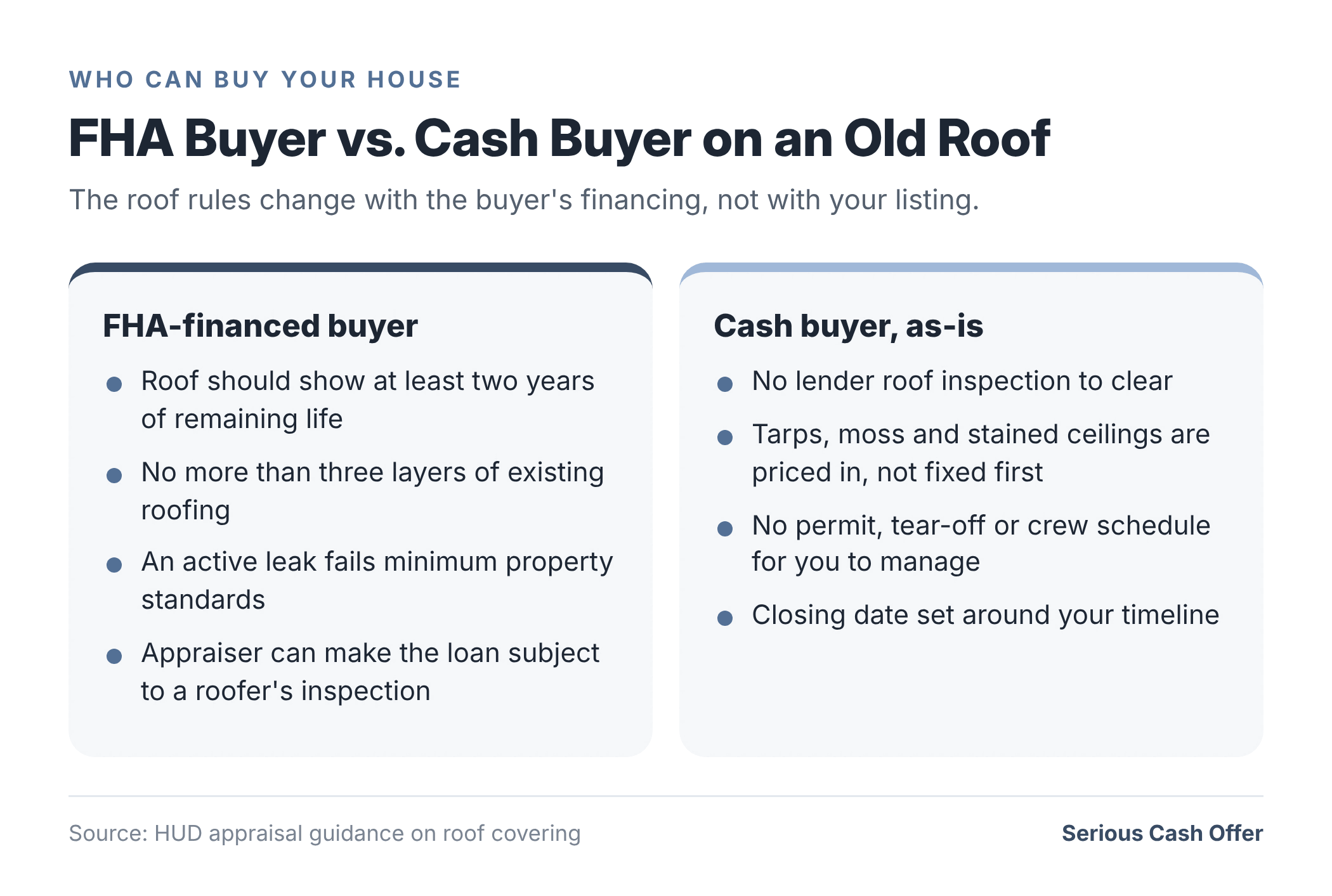
What changes isn’t whether you can sell. It’s who can buy. An FHA buyer walks into a different set of rules than a cash buyer does, and that difference drives most of this article. HUD’s appraisal guidance says the roof should have at least two years of remaining physical life. If it doesn’t, the appraiser has to report that condition, and the loan gets made subject to a roofer’s inspection. You can read the agency’s own summary of those roof and attic standards in the HUD appraisal reference.
Conventional lenders aren’t quite as rigid. Their appraisers still flag active leaks and visible deck sag, and those notes tend to turn into appraisal-required repairs before closing.
On a Tuesday last year, a young couple in Spanaway called me with an auction date on the calendar and three missed mortgage payments behind them. Their roof had two layers of asphalt shingle and a tarp over the garage side, and their agent told them to fix it first. No roofing crew I know of was starting a tear-off before that sale date, so following the advice would’ve cost them the house.
So the honest framing isn’t whether a Washington buyer exists for your old roof. One does. What matters is what that buyer pays, how long they take, and whether your timeline can absorb a roof replacement at all. With time and cash, you have real options. Without either, you have fewer, though you’re not stuck. The worst outcome I see is a homeowner paying for a roof replacement they’ll never recover because somebody told them it was mandatory.
What Roof Problems Scare Away Washington Buyers
Three layers. That’s the number that ends a sale. FHA accepts a maximum of three layers of existing roofing, and a roof that needs work on top of that stack is looking at a full tear-off before the loan funds.
Moss is the Puget Sound special. Buyers from Olympia to Bellingham know thick green growth holds moisture against the shingle granules and shortens the life of the whole assembly. Light scattering reads as neglect. Buyers see a solid mat over the north slope and price a roof replacement into the offer.
Interior stains scare people more than anything outside. A brown ring on a bedroom ceiling makes a buyer imagine rot in the walls, mold in the attic, and a contractor they haven’t met yet. Fair or not, their inspector will document it, and their lender will ask about it.
Curling edges scare buyers off too. So do bare patches where granules have washed into the gutters, and chimney flashing that someone caulked instead of replaced. An active leak fails HUD’s minimum property standards no matter what the remaining-life estimate says.
Paperwork carries real weight here. I don’t discount a roof I can date, with a permit and a transferable warranty. An undated roof of unknown origin gets treated as the oldest it could plausibly be. Two Washington houses with identical shingles can land thousands apart because one seller kept the roof replacement records and the other didn’t.
Should I Replace My Roof Before I Sell My House in Washington
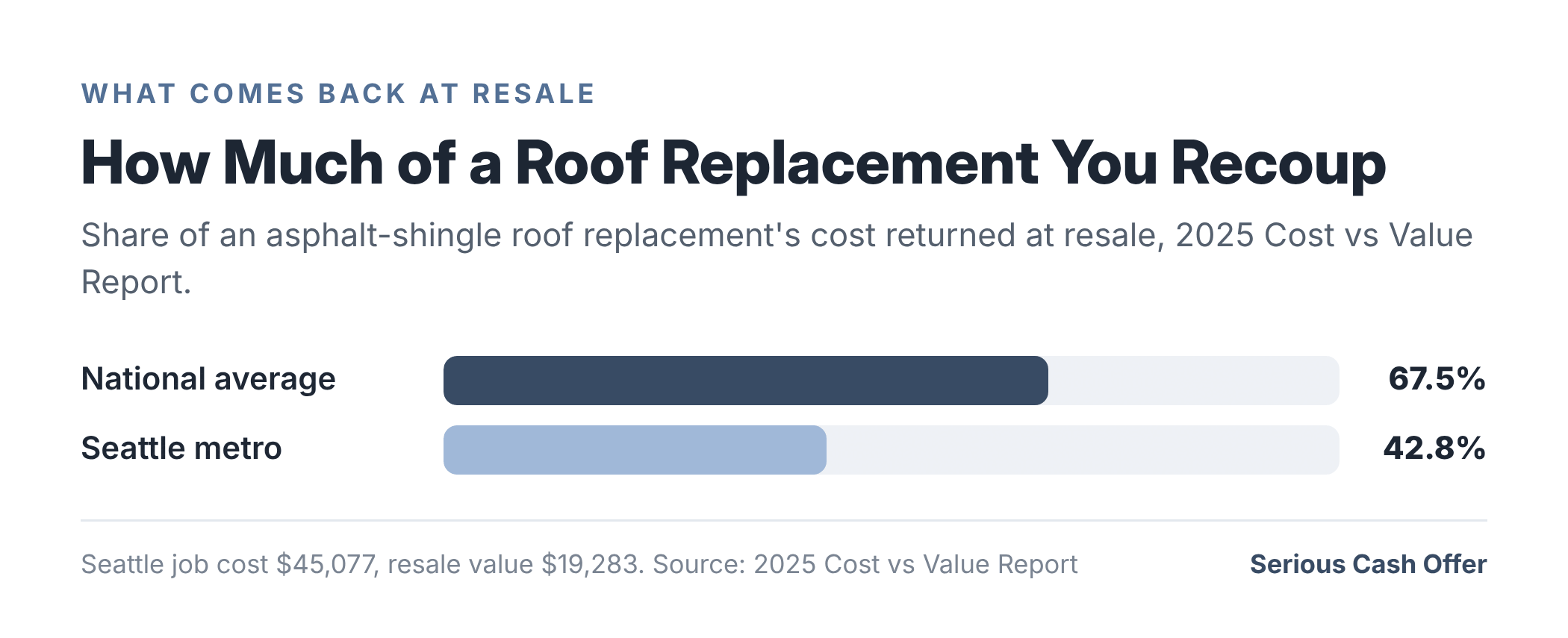
The plan sounds clean on paper. Spend fifteen grand on a roof replacement, add twenty to the price, pocket the difference. Then the appraisal comes back at neighborhood value, not value plus a new roof, and the math collapses. National data says the same thing. The 2025 Cost vs Value Report puts an asphalt-shingle job at about 67.5 percent of its cost recouped at resale.
Losing a third of your money is only a bad trade if you had a choice.
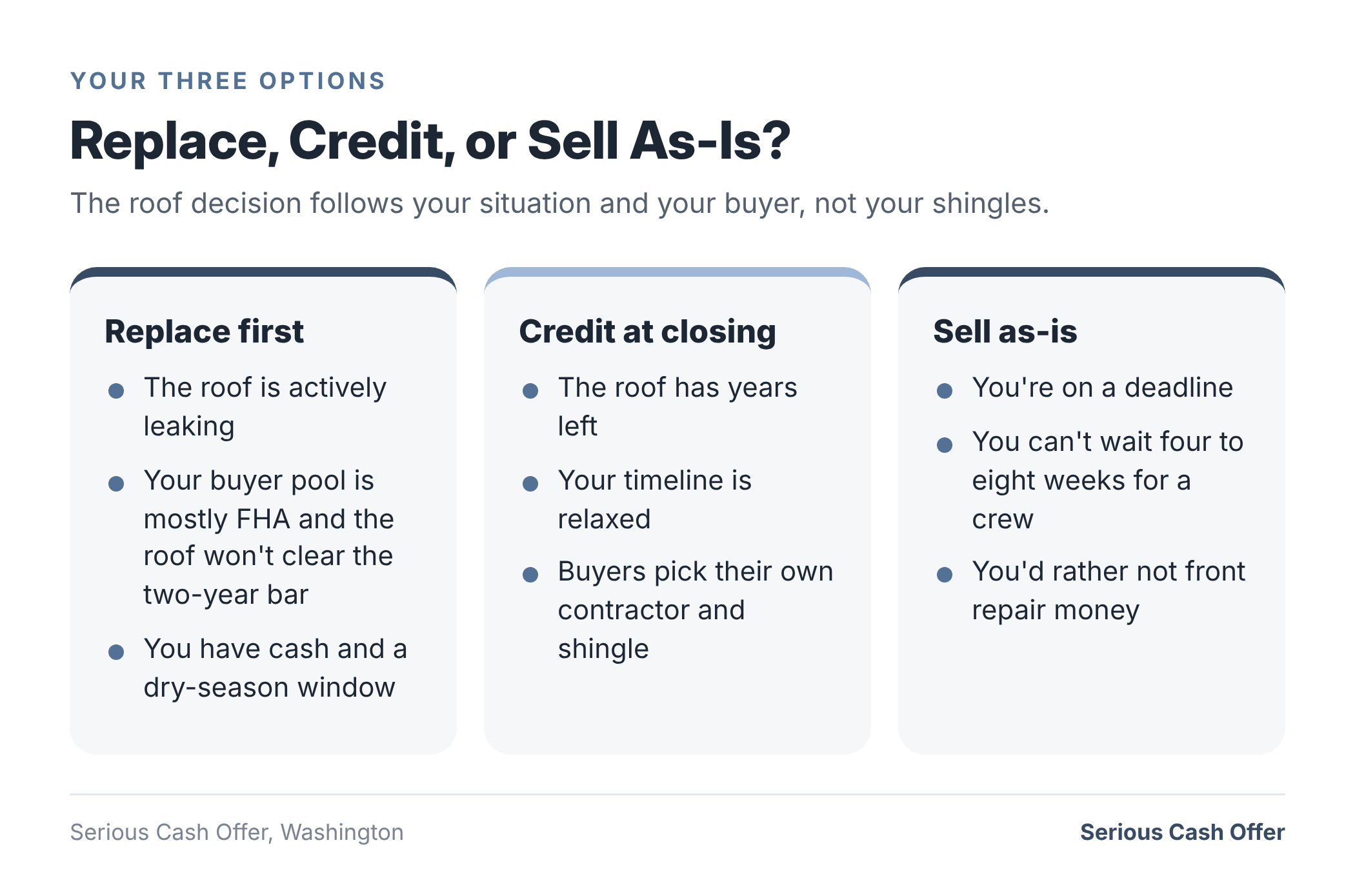
Here’s where I part ways with the standard advice. A roof replacement before listing makes sense in exactly two situations. Your roof is actively leaking, or it’s bad enough that financed buyers can’t get approved and you need the broad buyer pool. Outside those two, a credit at closing almost always beats writing the check yourself. Buyers get to choose their own shingle color and contractor, and you skip the permit, the dumpster in the driveway, and weeks of scheduling roulette.
I’ve watched sellers in Everett and Vancouver pay for a new roof, then sell for roughly what their neighbor got with an older roof and a repair credit. Same net. More stress.
Your situation decides the roof replacement question, not your shingles. Are you selling because you want to, or because you have to? A Washington homeowner facing a job relocation, a divorce, or a payment they can’t make doesn’t have eight weeks for a roof replacement. What that seller needs is certainty, which usually means selling a house that needs repairs as it sits.
Curious what that looks like with a cash buyer? You can see how our process works.
Does a New Roof Increase Home Value in Washington
“Will I get my money back?”
Partially, and the Seattle numbers are tougher than the national ones. The same report prices a Seattle asphalt-shingle replacement at $45,077, with $19,283 coming back at resale. That’s roughly 42.8 percent recouped, according to the Seattle Cost vs Value figures. Composition shingle still beats metal, which recovers less of its cost in the same table.
Replacing a failed roof is a different calculation entirely. You’re not buying value there. Instead, you’re removing a deduction, and it can be larger than the job. A useful break-even test: multiply your roof replacement estimate by the share the report says you’ll recoup. If that figure comes in under the discount your agent expects buyers to demand for the old roof, replacing it is the better financial move.
Buyers price roofs regionally here. Spokane’s median sold price was $610,000 with 58 median days active as of October 2026, so Spokane sellers face buyers who think hard about snow load and freeze-thaw on a roof past 20 years. In Tacoma or Shoreline, the same buyer worries about sustained winter rain and moss.
One material lesson I keep relearning: matching the neighborhood beats upgrading past it. I’ve watched sellers sink money into standing-seam metal on a 1970s rambler in a street of asphalt shingle roofs, and it won’t return what it cost. Mid-range architectural shingle is the Washington default for a reason, and appraisers treat it as the baseline.
Does a roof replacement lift your number? Some. Does it lift it enough to justify fronting the cash during a stressful sale? Frequently not.
How Much Does a Roof Replacement Cost in Washington
A seller in Puyallup once showed me two estimates for the same roof, and one was more than double the other. Both contractors were licensed and local. The gap came down to tear-off layers, underlayment grade, and whether the dry-rotted decking got replaced.
Prices across the state land in a wide band. Size, pitch, access, material and the number of layers coming off all move the figure, and the Seattle average above shows how high a full job can run in the metro. Smaller ranches with one layer and easy access come in well under that. Steep two-story homes, metal, and designer profiles land well above it.
Permits get forgotten, and they add a line item. Fees vary by city and county, and many jurisdictions scale them to project value. Your building department can confirm what yours runs before you sign anything.
Tear-off and disposal aren’t trivial either. Each extra layer means more labor, more dumpster weight, and more chance of finding soft plywood underneath. Stack a second layer on top and you’re adding thousands before a single new shingle goes down.
Never pay a deposit over a third of the contract. Don’t accept an estimate that skips decking contingency language, because Washington rain finds soft plywood and you’ll get a change order mid-job. And don’t assume the cheapest estimate covers the same scope as the expensive one. Read what each roofing contractor is tearing off.
Homeowners who’d rather not spend any of this sometimes get a competing number from Serious Cash Offer and compare their as-is net against listing after a roof replacement. Seeing both figures side by side settles it fast.
How Long Does a Roof Replacement Take Before Selling
The tear-off takes a day or two. Getting on the schedule takes four to eight weeks, and that gap is the part that wrecks Washington closing timelines.
Our weather owns the calendar. Crews west of the Cascades book out hard from June through September, the dry window. Anyone calling in late August for a September job is competing with everyone who had the same realization. Winter work happens, though rain can stretch a two-day roof replacement across two weeks of starts and stops.
Compare that against how fast Washington homes move. Homes that sold statewide over the 90 days ending October 28, 2026 spent a median of 33 days active, according to Beyond Real Estate’s NWMLS summary. Add roughly a month for a financed closing and you’ve got a two-month runway from listing to funds. A roof replacement scheduled before you list can easily eat more calendar than the sale itself.
Material lead time bites too. Standard architectural shingles usually sit in stock, while specialty profiles, cedar, and metal panels get ordered on a schedule that ignores your closing date.
Selling in spring? Start calling roofing contractors in February, since the best months to list in Washington line up with the busiest months for crews. Almost nobody plans that far back.
For anybody on a deadline (a relocation start date, a loan modification that fell through, a probate court schedule), the sequencing just doesn’t work. You can’t finish a roof replacement, list, market, and close inside eight weeks in most Washington markets. One of those steps has to go.
What Do Washington Home Buyers Expect From a Roof
Get this wrong and your buyer walks at day 12 of inspection, and every later buyer asks what happened.
Most Washington buyers want a roof with visible life left, not a brand-new roof. Asphalt shingle roofs commonly last around two decades with decent care, so age alone isn’t the whole story. A roof at year 14 with clean flashing and no moss reads fine. The same roof at year 22 reads as a bill coming due.
Insurance has tightened the screws on roof replacement timing too. Several insurers now underwrite older roofs differently, and a buyer who can’t bind homeowner coverage at a reasonable premium can’t close. I’ve had sales where the insurer, not the home inspector, was the one who killed the financing.
What does a buyer want to see from you? Proof. A dated invoice, the permit record, and a warranty they can transfer all help. Documented work holds its value, while the same roof replacement without paperwork gets discounted because the buyer has to verify it.
Washington’s climate shapes expectations by region. Coastal and Sound-area buyers look for ridge venting and gutter condition, since trapped attic moisture does as much damage here as any storm. Buyers in Yakima and the Tri-Cities care more about UV wear and heat cycling.
Price honestly and the roof stops being a weapon. List at full retail with a 23-year-old roof and you hand the buyer a negotiating hammer at inspection. Sellers who price in the roof replacement up front, or who sell as-is to a cash buyer, keep control of the conversation.
Key Takeaways for Washington Home Sellers
For years I told sellers to do the roof replacement first, every time. I was wrong often enough to change my mind.
What I believe now is narrower. Replace it if it leaks. Do the roof replacement if your buyer pool is mostly FHA and the roof won’t clear the two-year remaining-life bar. Otherwise, price it in or credit it, and keep your cash.
Washington’s market gives you room to make that choice deliberately. Statewide supply sat at 4.1 months of inventory in late October 2026, which is a balanced market rather than a frenzy. Balanced markets reward correct pricing more than they reward renovations.
Know your buyer before you spend. Financing looks different on a modest rambler in Lacey than on a luxury house on Mercer Island, and the roof replacement decision follows the financing, not the shingles.
Get three estimates minimum from roofing contractors registered in Washington. The L&I contractor lookup lets you check registration and bond status before anybody climbs a ladder.
Run your net both ways. One column assumes a roof replacement, agent commissions, holding costs, and a retail sale. The other assumes an as-is cash sale with no repairs. Homeowners who do that arithmetic rarely agonize afterward, and some of them call cash home buyers in Washington simply to get a real number for the second column.
The deferred maintenance on your roof isn’t a moral failing. It’s a line item, and line items have more than one solution.
Our Service Areas Across Washington
A landlord in Wenatchee reached out while her father was settling into assisted living. The rental she’d managed for eleven years had cupped shingles and a detached garage full of his woodworking tools. Squeezing out every dollar wasn’t her goal. She wanted to stop driving over the pass every other weekend.
We buy houses throughout Washington, from the Puget Sound corridor out to the Columbia Basin.
King County remains the state’s priciest major market. Its median sold price was $830,000 with 31 median days active as of late October 2026, so even expensive homes there sit long enough for a roof problem to surface.
Pierce County sellers in Tacoma, Lakewood, and Gig Harbor call us often, usually about mid-century homes with original decking. Thurston County covers Olympia and Tumwater, where damp winters make moss and gutter condition the first thing I check.
Over in Clark County, Vancouver sellers face a median sold price of $509,900 with 32 median days active in the same October 2026 county breakdown.
Eastern Washington works differently. Spokane, Yakima, and Moses Lake have longer market times and more price sensitivity, so a roof replacement there has to clear a lower price ceiling to make sense.
Smaller towns like Aberdeen, Port Angeles, Centralia, and Walla Walla count too, and a roof needing replacement is one of the most common reasons a rural Washington listing stalls.
When Selling As-Is Beats a Roof Replacement
The landlord in Wenatchee took an as-is offer, kept the woodworking tools, and finished in under three weeks without meeting a roofing contractor. Not every seller wants that ending. It was right for her.
If your roof has years left and your timeline is relaxed, listing with a good Washington agent and crediting the buyer is probably your best net. With a shot roof, cash on hand, and a summer window, a roof replacement before listing can widen your buyer pool enough to pay for itself.
And if neither of those describes you, selling as-is is a legitimate third door, not a consolation prize.
We look at Washington houses in whatever condition they’re in: tarps, moss, stained ceilings, three layers of asphalt, all of it. There are no repairs, no cleaning, and no permits for you to pull.
Frequently Asked Questions
Does Putting a New Roof on Your House Add Value?
It adds value, though not dollar for dollar. National remodeling data shows you get back roughly two-thirds of what a roof replacement costs when you upgrade a roof that still worked. The stronger argument for a new roof is that your house becomes financeable and insurable for a much wider pool of Washington buyers.
Which Month Is the Best to Sell a House in Washington State?
Late spring through early summer, generally. Washington buyers come out when the rain lets up, inventory is fresh, and families want to close before the school year. If your roof is rough, that dry season is also when roofing contractors are hardest to book, so plan backward from your target list date.
What Time of Year Is the Cheapest to Replace a Roof?
Late fall and winter, when Washington crews have open calendars and more room to negotiate. The tradeoff is weather, since a job that takes two days in July can stretch across weeks of rain delays in January. If you’re not in a hurry and your roof isn’t leaking, an off-season roof replacement usually costs less than the same work booked in August.
What Is the Average Cost to Replace a Roof on a 2,000 Square-foot Home?
It depends on pitch, access, how many layers come off, and whether the decking underneath is sound. Steep roofs and multi-story homes cost more per square than a simple ranch. Get three written estimates that spell out the same scope, because the spread between contractors on identical work is wide.
Can I Sell a House in Washington with an Active Roof Leak?
You can, though your buyer pool narrows to cash buyers and renovation-loan borrowers. An active leak fails federal minimum property standards, so conventional and FHA financing generally stalls until it’s fixed. Disclose it on your Washington seller disclosure form either way, since hiding a known leak creates problems far more expensive than the roof itself.
If you want to talk through your roof, your timeline, and what your house is worth as-is versus after repairs, we’re happy to run the numbers with you. You’ll get an honest read on which direction nets you more, with no pressure and no hard feelings if you decide to list instead. Reach out to Serious Cash Offer or fill out the form below whenever you’re ready.
Helpful Blog Articles
- Difference between a short sale and foreclosure
- How to sell a house and move out of state
- Can someone take over my mortgage
- Selling Your Home After One Year: Is It a Good Idea?
- Can an Executor Sell Estate Property Without Beneficiary Approval?
- What Happens If a Seller Refuses to Close on Your Home Purchase
- Should I Remodel My Kitchen Before Selling My Home?
- How Soon After Chapter 7 Can I Sell My House
- How to Find a Realtor in Another State
- How to Get Someone Out of Your House Legally
- Will I Lose Medicare If I Sell My House